Fingerprint match implicating Jacob Barber
Defending JacobThe fingerprint match implicating Jacob Barber is the first specific forensic link between Jacob and the killing of Ben Rifkin. A print left on the inside tag of Ben’s unzipped sweatshirt is identified as Jacob’s right thumbprint, changing the case from an investigation with an unidentified trace into one that points toward the son of the investigator assigned to it. The match is both a central piece of evidence and a personal rupture for Andrew Barber: he is placed on paid leave, barred from his case materials, and replaced by Neal Logiudice.
The fingerprint at the scene
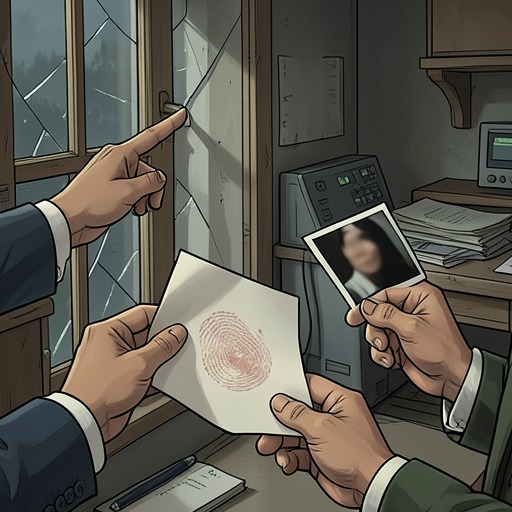
Ben’s body was found in Cold Spring Park, where the initial examination revealed no defensive wounds and the murder weapon was not recovered. Among the limited physical clues was a single clear fingerprint preserved in Ben’s blood on a plastic tag inside his unzipped sweatshirt. The position of the print suggested that someone could have grabbed Ben by the sweatshirt, but the trace itself did not identify its maker until investigators compared it with known prints. At first, it matched neither Ben nor Paula Giannetto, the woman who discovered the body.
The placement mattered as much as the identification. Investigators understood the print to be on the inside tag, not simply somewhere on the garment: the report’s account was that Jacob had reached out and grasped the sweatshirt, leaving his right thumb there. That specific contact made the forensic result consequential, while the print’s presence alone did not supply a complete account of when or why Jacob touched the garment.
The laboratory match
The revelation comes when Andrew is told that the print from the Rifkin case belongs to his son. A stapled report from the State Police Crime Lab gives the conclusion institutional weight: it identifies twelve points of comparison between the latent print recovered at the murder scene and a known print on Jacob’s fingerprint card. The report notes that twelve points exceed the eight ordinarily required for a positive match.
Andrew scans the report and responds that there must be an explanation. His bewilderment registers the collision between a result described in precise technical terms and the parental certainty that the result cannot straightforwardly mean what it appears to mean. The colleague delivering the news answers that there must be an explanation too, but that shared reassurance does not undo what the report establishes: the fingerprint is attributed to Jacob, and the case has acquired direct forensic evidence connecting him to the victim’s clothing.
Andrew removed from the case
The match also changes Andrew’s position within the investigation. He is told that he will be put on paid leave, partly because allowing him to handle the case had been a mistake. Troopers will accompany him to his office so that he can retrieve personal belongings; he may take no papers or files and must not touch the computer. The work product belongs to the office, a reminder that his professional role and his personal stake are now in direct conflict.
When Andrew asks who will take over, he is told that Neal will. Andrew’s brief response conveys recognition of the reversal: Neal, formerly his colleague and now his professional adversary, is to try the case. The transfer follows the forensic finding not as proof of Jacob’s guilt, but as an immediate consequence of the conflict created by the match and Andrew’s relationship to the suspect.
Significance and limits
The match transforms a clue that had remained anonymous into a named connection to Jacob. Its numerical detail—the twelve points of comparison against a stated standard of eight—makes the finding concrete and difficult for Andrew to dismiss, even as he instinctively reaches for another explanation. The scene’s force lies in that tension: the laboratory can identify whose print it is, while the print by itself cannot narrate the full circumstances of the contact.
For the investigation, the fingerprint redirects attention toward Jacob and places the case in Neal’s hands. For Andrew, the same evidence divides his roles as investigator and father: the report is not merely a piece of casework but the reason he loses access to the investigation. The result therefore carries two linked consequences, one evidentiary and one personal, without resolving the larger question of what the fingerprint alone can prove about the murder.